Understanding Zirconia Grades: Which One Is Right for Your Case?
By DA’AT Lab Team
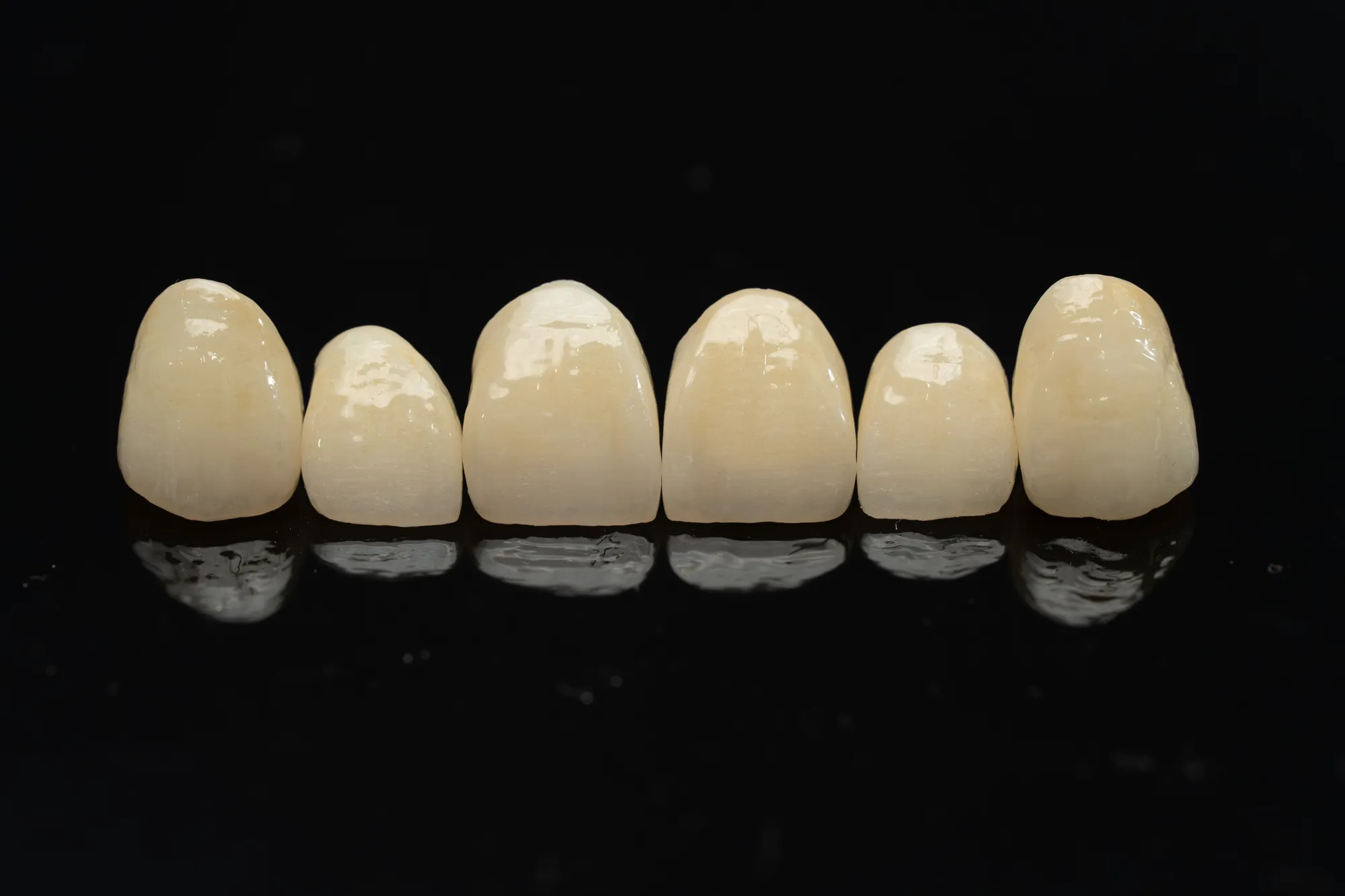
From 3Y, 4Y and 5Y to multilayer, seamless-gradient and bilayered systems.
A 2026 clinician–laboratory guide covering the newest zirconia restorations from Ivoclar, Argen, VITA, Aidite, KATANA and BruxZir.
What has changed in zirconia?
- 3Y, 4Y and 5Y still matter. More yttria generally raises translucency but reduces transformation toughening, fracture toughness and flexural strength.
- “Multilayer” is not one material class. Some blanks change only color; others change color, translucency and mechanical composition.
- Transition lines are primarily an optical problem. Abrupt pigment or composition zones can create visible horizontal bands, particularly in short crowns, thin restorations and adjacent anterior units nested at different heights.
- The newest universal discs aim for broader transitions. Ivoclar uses GTx Technology, Argen uses Smart Gradient, VITA uses Multi-Gradient, and Aidite describes a layerless natural transition. These are proprietary terms rather than a single standardized technology.
- Not every new esthetic zirconia is a seamless gradient disc. KATANA YML remains a defined multilayer gradient system, while BruxZir Fusion uses two separately milled zirconias joined as a bilayered restoration.
1. The traditional 3Y, 4Y and 5Y classification
The “Y” number describes the approximate molar percentage of yttria used to stabilize zirconia. It is a useful starting point, but not a complete specification: grain size, alumina content, pigments, pressing, milling damage and sintering protocol also change the final performance.[1]
3Y-TZP: strength first
Three-mol-percent yttria-stabilized tetragonal zirconia polycrystal contains a large metastable tetragonal fraction. Stress at a crack tip can trigger a tetragonal-to-monoclinic transformation with local volume expansion, placing the crack in compression. This transformation-toughening mechanism explains the comparatively high strength and fracture toughness of 3Y materials. The trade-off is lower translucency and a more opaque appearance.[1]
4Y-PSZ: the universal middle ground
Four-mol-percent partially stabilized zirconia contains more optically favorable cubic phase than 3Y while retaining more tetragonal content than 5Y. Modern 4Y products are frequently positioned for universal crowns and selected bridges because they provide a practical compromise between masking, translucency and load capacity.[1]
5Y-PSZ: translucency first
Five-mol-percent partially stabilized zirconia contains more cubic phase and less transformable tetragonal phase. It transmits more light, but its lower fracture toughness and strength demand conservative indication, thickness and connector selection.[1]
Do not select by “MPa” alone. A published flexural-strength value is not a universal property of every restoration made from a disc. Test geometry, specimen preparation, surface condition, sintering and the zone sampled can change the result. Manufacturer values are useful within one system, but cross-brand comparisons should be interpreted cautiously.
2. Multilayer zirconia: what the term actually means
Early zirconia discs were monochromatic: one shade and one material composition throughout. Multilayer discs improved efficiency by building cervical, body and incisal effects into the blank. However, two different technologies are often grouped under the same “multilayer” label.
Color multilayer
The base zirconia composition remains essentially the same from top to bottom while pigment concentration changes. The restoration gains a cervical-to-incisal color progression, but translucency and strength remain broadly similar through the disc. KATANA UTML, STML and HTML Plus are current examples in which the manufacturer identifies color gradation with a uniform base material within each product.[7]
Composition or strength-gradient multilayer
Different zirconia compositions are combined within one blank. A typical design places a stronger 3Y or 4Y region cervically and a more translucent 5Y region incisally. The restoration therefore has location-dependent optical and mechanical properties. Recent research confirms that the enamel, transition and dentin zones of 4Y/5Y multilayer zirconia can differ significantly in yttria content, translucency and flexural behavior.[2]
Why visible transition lines can occur
- Abrupt shade steps. Pigment changes between discrete layers may appear as a horizontal band rather than a natural diffusion.
- Short clinical crowns. A small crown may cross several transitions within only a few millimeters, compressing the gradient.
- Incorrect vertical nesting. Placing the restoration too high or too low can create an overly translucent cervical zone or an opaque incisal zone.
- Adjacent units nested at different heights. Even a subtle vertical mismatch can create repeated horizontal lines across an anterior case.
- Thin walls and dark substrates. Preparation color, titanium bases or metal abutments can exaggerate a sudden value change.
- Finishing and sintering. Surface texture, stain thickness and an unvalidated fast-sintering schedule can change perceived value and translucency.
Important distinction. A visible transition line is not automatically a physical delamination or weak “joint.” It is usually an optical band caused by how the zones interact with restoration geometry, light and the underlying substrate. Nevertheless, mechanical properties can also vary by zone, so connector placement remains important.
3. The newest gradient technologies
The current trend is to replace clearly stepped layers with broader, more controlled transitions in powder composition, shade and translucency. The goal is not to eliminate the strength–translucency trade-off, but to distribute it anatomically: stronger and more masking cervically, more translucent incisally.
- Layer-free or continuous-gradient claims. Ivoclar and Aidite explicitly describe layer-free or layerless transitions; Argen describes seamless transitions; VITA describes a coordinated multi-gradient.
- More complex disc engineering. Manufacturers combine powder conditioning, mold filling, shading and pressing to control shrinkage and property changes through the blank.
- Universal inventory positioning. Several newest products are marketed as one-disc systems spanning veneers, crowns, bridges and full-arch restorations.
- Greater responsibility in CAM. The disc may be more forgiving visually, but connectors and stress-bearing regions still need to occupy zones permitted by the IFU.
Terminology warning. “GTx,” “Smart Gradient,” “Multi-Gradient,” “seamless” and “layerless” are manufacturer-specific terms. Evaluate the actual yttria composition, zone thickness, strength profile, indications and nesting rules rather than assuming all gradient products are equivalent.
Ivoclar — IPS e.max Zirconia
Newest flagship: 4Y-PSZ / 5Y-PSZ universal disc with GTx Technology.
IPS e.max Zirconia is Ivoclar’s current new-generation zirconia and should not be confused with IPS e.max ZirCAD Prime. Ivoclar states that GTx Technology is the next generation of the Gradient Technology introduced with ZirCAD Prime in 2019. The process combines powder conditioning, in-house shading, proprietary mold filling and two-stage pressing to produce a smooth, layer-free transition.[3]
| Feature | Current published specification |
|---|---|
| Material structure | 4Y-PSZ dentin region transitioning to 5Y-PSZ incisal region |
| Flexural strength | 1,200 MPa (4Y) and 800 MPa (5Y), manufacturer values |
| Disc architecture | 3 mm fixed incisal zone; 4 mm fixed transition; 5–23 mm variable dentin zone |
| Formats / shades | Open 98.5 mm discs; 12–30 mm heights; 20 A–D and bleach shades |
| Indication range | Veneers ≥0.5 mm, crowns, multi-unit bridges, hybrid structures and All-on-X within the IFU |
| Sintering options | 58 min for single crowns / 3-unit bridges; 2 h 57 min up to full arch; 9 h 50 min standard |
Clinical-laboratory interpretation: the new disc raises the incisal strength from the 650 MPa published for ZirCAD Prime to 800 MPa while moving the dentin composition from 3Y in Prime to 4Y in IPS e.max Zirconia. It therefore prioritizes a more esthetic universal balance rather than reproducing Prime’s maximum 3Y cervical strength.[3]
Main limitation. The disc is seamless optically, but not mechanically uniform. The 5Y incisal region remains lower in strength than the 4Y dentin region. Long-span connectors and high-stress basal regions still require correct nesting and adherence to the technical guide.
Argen — ArgenZ GT
Newest 2026 launch: Smart Gradient universal zirconia.
Argen announced ArgenZ GT in 2026 as a universal gradient-translucent zirconia for single crowns through full-arch restorations. Its patented Smart Gradient Technology is promoted as producing seamless shade and translucency transitions with micro-mamelon effects, while the True Shade process targets repeatable shade consistency between discs and batches.[4]
| Feature | Current published specification |
|---|---|
| Gradient concept | Smart Gradient with micro-mamelon optical effects |
| Flexural strength | 1,250–850 MPa; 1,000+ MPa in the transitional incisal layer |
| Translucency | 45–50%, manufacturer value |
| Indication range | Single units through full-arch restorations |
| Portfolio position | Newest universal flagship; current Argen portfolio also retains indication-specific HT+, ST, anterior, esthetic and high-strength zirconias |
Evidence status. ArgenZ GT is exceptionally new. Its published performance and micro-mamelon claims are primarily manufacturer generated at the time of this article; independent long-term clinical evidence will necessarily lag behind the 2026 launch.
VITA — VITA YZ Multi Translucent
Latest premium system: coordinated shade, translucency and strength gradient.
VITA YZ Multi Translucent is VITA’s latest premium zirconia. The material combines 4Y-TZP cervically with 5Y-TZP incisally, creating coordinated gradients in shade, translucency and strength. VITA reports approximately 1,200 MPa cervically and 850 MPa incisally, with cubic content increasing from about 33% to approximately 55%.[5]
| Current VITA material | Yttria / architecture | Published strength | Published translucency | Primary positioning |
|---|---|---|---|---|
| YZ T | 3Y, uniform | 1,350 MPa | 32% | Framework / maximum masking |
| YZ HT | 3Y, uniform | 1,350 MPa | 42% | High-strength, more translucent |
| YZ ST / ST Multicolor | 4Y, uniform or color multilayer | 1,200 MPa | 46% | Universal posterior / longer spans |
| YZ XT / XT Multicolor | 5Y, uniform or color multilayer | 850 MPa | 50% | High-esthetic anterior / short spans |
| YZ Multi Translucent | 4Y → 5Y multi-gradient | 1,200 → 850 MPa | 46 → 50% | Latest broad-indication premium disc |
VITA additionally promotes a 50-minute YZ Speed program for restorations up to 14 units. As with all fast cycles, use the exact validated furnace program and restoration limits rather than transferring a schedule from another zirconia.[5]
Main limitation. Multi-gradient does not remove the need to position the restoration correctly. Very short crowns may display only part of the intended gradient, and regional indications can differ even when the same product name is used.
Aidite — 3D Pro Zir Ultra and 3D Pro Zir MAX
Current newest products split “universal gradient” and “demanding long-span” roles.
Aidite’s 2026 portfolio is broader than the original 3D Pro Zir alone. The most relevant current products are 3D Pro Zir Ultra, a 4Y+5Y composition-gradient material, and 3D Pro Zir MAX, a next-generation high-strength multilayer product developed for demanding long-span cases.[6]
| Current Aidite material | Architecture / published value | Best understood as |
|---|---|---|
| 3D Pro Zir Ultra | 4Y cervical + 5Y incisal; up to 1,250 MPa; 43% → 57% translucency; accelerated sintering | Newest esthetic universal gradient for crowns through 14-unit restorations |
| 3D Pro Zir MAX | Official materials describe 4Y-TZP and ≥1,300 MPa | Newest high-strength long-span / implant-supported option |
| 3D Pro Zir | 4Y+5Y; up to 1,100 MPa; “layerless natural transition” | Established universal gradient platform |
| EZneer | Zirconia specifically developed for thin veneers | Specialized high-translucency veneer workflow |
| AiZir / AiZir Flash family | Rapid-sintering and workflow-specific zirconias | Efficiency-focused alternatives |
| Superfect Zir / Honor Zir | Additional esthetic and indication-specific materials | Broader regional portfolio |
Aidite’s current product pages specify a two-hour fast cycle for 3D Pro Zir Ultra single crowns and short bridges when paired with the CSF-400 Pro workflow. Older and regional brochures may describe different furnace/program combinations, so the current furnace-specific protocol must control production.[6]
Main limitation. Aidite updates products, naming and furnace workflows quickly. Avoid treating “3D Pro” as one unchanging material. Confirm whether the case is being made in standard 3D Pro, Ultra or MAX and use that product’s current regional IFU.
KATANA — KATANA Zirconia YML
Current gradient flagship; no newer zirconia disc was found in the official current family.
As of July 2026, KATANA Zirconia YML remains Kuraray Noritake’s latest multilayer disc with a combined color, translucency and strength gradation. The rest of the current family—HTML Plus, STML and UTML—uses a color gradient while keeping the same base material and properties throughout each respective disc.[7]
| Current KATANA material | Published flexural strength | Published translucency | Architecture / role |
|---|---|---|---|
| YML enamel | 750 MPa | 49% | High-translucency top zone |
| YML body 1 | 1,000 MPa | 47% | Intermediate transition |
| YML body 2 / 3 | 1,100 MPa | 45% | High-strength lower body |
| HTML Plus | 1,150 MPa | 45% | Uniform base material with color gradation; strength-oriented |
| STML | 748 MPa | 49% | Uniform base material with color gradation; esthetic universal |
| UTML | 557 MPa | 51% | Uniform base material with color gradation; maximum translucency |
YML’s disc is deliberately zoned rather than described as layer-free. The official FAQ assigns 35% of the height to enamel, 15% to body 1, 15% to body 2 and 35% to body 3. For restorations of four units or more, at least 50% of the connector cross-section should be positioned in the lower half of the disc.[7]
Why KATANA remains relevant. YML demonstrates that a well-engineered defined-layer system can still deliver a smooth clinical gradient. “Newest” does not automatically mean that an older zoned architecture is obsolete; predictable CAM positioning and a mature workflow may be more valuable than a marketing claim of seamlessness.
BruxZir — Fusion, Radiant, Esthetic and Full-Strength
Newest concept: bilayered zirconia-to-zirconia, not a seamless-gradient disc.
BruxZir should be compared differently from open 98-mm disc systems because Glidewell primarily presents it as a finished-restoration ecosystem. The latest all-zirconia concept is BruxZir Fusion: an anatomically shaped 3Y Full-Strength core is milled separately from a wraparound 5.8Y Radiant veneer, then the two zirconias are joined. This recreates dentin–enamel architecture through a discrete bilayer rather than a gradient inside one puck.[8]
| Current BruxZir restoration | Published composition / strength | Primary role |
|---|---|---|
| BruxZir Fusion | 3Y substructure >1,000 MPa + 5.8Y veneer 778 MPa | Newest high-esthetic bilayered all-zirconia crown/bridge |
| BruxZir Radiant | 5.8Y monolithic zirconia, 778 MPa | Veneers, crowns and bridges up to 3 units |
| BruxZir Esthetic | Monolithic zirconia, 870 MPa | Broad esthetic crown-and-bridge use |
| BruxZir Full-Strength | 3Y monolithic zirconia, >1,000 MPa | Bruxers, posterior, implant and long-span indications |
| BruxZir NOW blocks | Fully sintered chairside/lab blocks, approximately 1,100 MPa | No post-milling sintering; single-unit efficiency |
BruxZir Glass is another current bilayered option, but it presses lithium disilicate over a zirconia core and therefore is not an all-zirconia restoration. It belongs in a broader discussion of zirconia-based esthetic restorations, not in a direct comparison of monolithic or gradient zirconia discs.[8]
Main limitation. Fusion’s high esthetics come from two separately manufactured parts, so it does not solve multilayer transition lines inside a milling blank. It is also a proprietary finished-restoration workflow rather than an open material that a laboratory can mill and process like the other discs in this article.
4. Current flagship comparison
| System | Architecture | Published strength profile | Transition concept | Key caution |
|---|---|---|---|---|
| IPS e.max Zirconia | 4Y → 5Y | 1,200 → 800 MPa | GTx; layer-free, two shaded powders | Universal, but zone strength still varies |
| ArgenZ GT | Gradient translucent | 1,250 → 850 MPa; 1,000+ transition | Smart Gradient; micro-mamelon effects | Very new; independent evidence is limited |
| VITA YZ Multi Translucent | 4Y → 5Y | 1,200 → 850 MPa | Multi-Gradient | Follow regional IFU and nesting |
| Aidite 3D Pro Zir Ultra | 4Y → 5Y | Up to 1,250 MPa | Layerless natural transition claim | Confirm exact furnace/program version |
| KATANA YML | Defined zoned gradient | 1,100 → 750 MPa | Four-layer strength/translucency map | Connector location matters in long spans |
| BruxZir Fusion | 3Y core + 5.8Y veneer | >1,000 / 778 MPa | Two zirconias fused as a bilayer | Not an open gradient disc |
Do not read this table as a ranking. The systems solve different problems. A seamless gradient may improve optical continuity; a defined zoned disc may improve control; a bilayered restoration may create greater depth; and a homogeneous 3Y material may remain the safest option for a demanding high-load design.
5. Practical material selection
Choose 3Y or a high-strength lower zone when:
- Long-span bridges, implant frameworks or full-arch prostheses place strength and fracture toughness first.
- Restorative space is limited or the patient has heavy parafunction.
- A dark preparation, metal abutment or titanium component requires stronger masking.
- The restoration will serve as a substructure for cutback and ceramic layering.
Choose 4Y or a 4Y–5Y gradient when:
- One material must cover anterior and posterior crowns with selected bridges.
- The cervical area needs masking and load capacity while the incisal area needs light transmission.
- Inventory simplification is valuable, provided the laboratory controls vertical nesting.
Choose 5Y or an esthetic upper zone when:
- The restoration is a veneer, anterior crown, inlay/onlay or short-span bridge with controlled load.
- There is adequate thickness and the preparation/substrate color supports the optical result.
- An adhesive strategy and conservative occlusal design are appropriate.
Use a bilayered system when:
- Internal anatomy, mamelons and wraparound translucency are more important than monolithic simplicity.
- The workflow can reliably join the layers and the case permits greater reduction than a minimal monolithic design.
CAM nesting checklist for gradient zirconia
- Confirm which side of the disc is enamel/incisal and lock the orientation before nesting.
- Place adjacent anterior units at the same vertical height unless intentional variation is planned.
- Keep connectors and basal stress-bearing regions in the manufacturer-approved stronger zone.
- For short teeth, decide whether cervical masking or incisal translucency is the priority; the full disc gradient may not fit inside the crown.
- Use the correct disc height. A thicker disc does not necessarily mean a proportionally larger incisal zone.
- Preview the substrate color and restoration thickness; translucent zones can amplify dark cores.
- Do not transfer fast-sintering schedules between brands or product generations.
Current evidence on speed sintering. A 2026 study of a tested multi-yttria layered zirconia found that high-speed sintering could reduce translucency and produce clinically relevant color shifts, especially in incisal and transition zones. This does not invalidate every manufacturer-validated rapid cycle, but it reinforces the need to use material-specific programs and verify shade outcomes in the laboratory.
Conclusion
The modern zirconia market has moved beyond selecting a single 3Y, 4Y or 5Y composition. The most advanced discs distribute different properties within the same blank, allowing strength, masking, shade and translucency to change from cervical to incisal. The central innovation is not simply “more translucent zirconia,” but more intentional placement of optical and mechanical behavior.
IPS e.max Zirconia and ArgenZ GT represent the newest 2026 universal-gradient launches. VITA YZ Multi Translucent and Aidite 3D Pro Zir Ultra pursue similar 4Y–5Y multi-property gradients. KATANA YML remains a mature, current zoned-gradient system. BruxZir Fusion takes a different route by digitally recreating dentin and enamel with two separately milled zirconias.
For the clinician and technician, the practical question is no longer only “Which zirconia is strongest?” It is: “Where is the strength, where is the translucency, and does the restoration’s design place each zone where it is clinically needed?”
References and current product sources
- Kongkiatkamon S, Rokaya D, Kengtanyakich S, Peampring C. Current classification of zirconia in dentistry: an updated review. PeerJ. 2023;11:e15669.
- Vardhaman S, Borba M, Kaizer MR, Kim DK, Zhang Y. Optical and Mechanical Properties of the Multi-Transition Zones of a Translucent Zirconia. J Esthet Restor Dent. 2025;37(2):525–532.
- Ivoclar. IPS e.max Zirconia — official product page, FAQ and technical information.
- Argen. ArgenZ GT — official product page and 2026 launch brochure.
- VITA Zahnfabrik. VITA YZ Multi Translucent and VITA YZ portfolio technical documentation.
- Aidite. 3D Pro Zir Ultra, 3D Pro Zir MAX, 3D Pro Zir and EZneer official product pages.
- Kuraray Noritake Dental. KATANA Zirconia YML FAQ and current KATANA Zirconia family.
- Glidewell. Current BruxZir Zirconia family and BruxZir Fusion official product information.
- Optical Properties of Multi-Yttria-Layered Zirconia: Influence of High-Speed Sintering Protocol. PubMed record, 2026.
This article was written with the assistance of AI.